What Is CCS2 and How Is It Used for EV Charging?
Learn what the CCS2 charging standard is, how it differs from Type 2, how DC fast charging starts and why CCS2 is more than a plug shape.
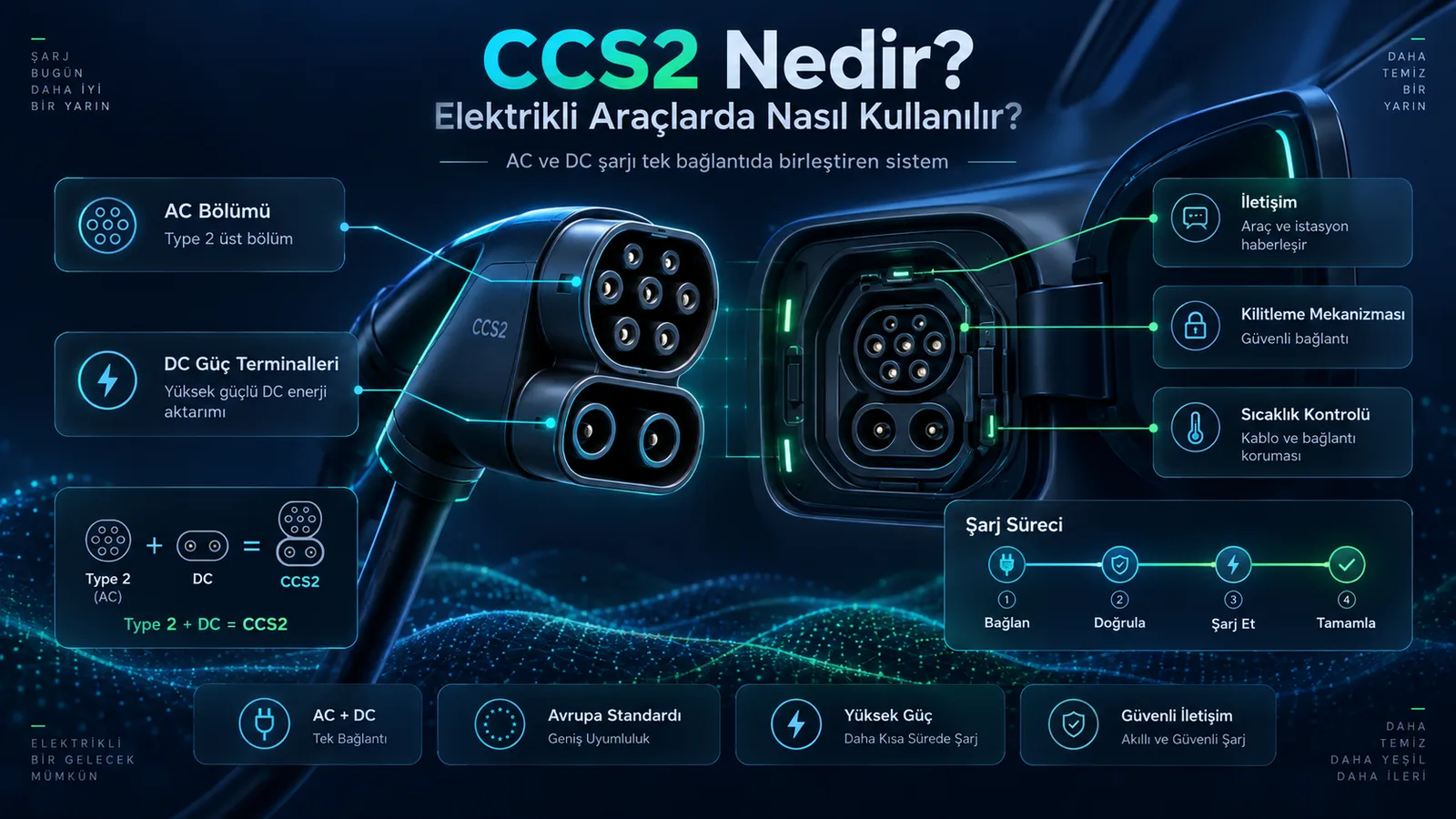
Table of contents
What Is CCS2 and How Is It Used for EV Charging?
CCS2 is one of the most common EV charging connections in Europe, especially for DC fast charging. It is more than the shape of a socket: the vehicle and station use the connection both to transfer energy and to communicate throughout the charging process.
What is CCS2?
CCS stands for Combined Charging System. Its purpose is to support both AC and DC charging through one vehicle inlet. CCS2 is the version based on the European Type 2 connector.
The upper part of a CCS2 vehicle inlet contains the Type 2 contacts. Two larger contacts below them are used for DC power. That is why a CCS2 connector is visibly larger than a standard Type 2 plug.
Why is it called a combined system?
The same vehicle inlet can be used with a Type 2 AC connection or with the full CCS2 connector for DC fast charging. The vehicle does not need two entirely separate charging inlets for these functions.
Are CCS2 and Type 2 the same thing?
No. Type 2 is the AC charging connection. CCS2 builds on that upper Type 2 arrangement and adds the DC power contacts below it. They are related, but a Type 2 AC plug does not itself provide DC fast charging.
How does a CCS2 DC session start?
High voltage is not applied immediately when the plug is inserted. In simplified form:
- The cable is connected and the station detects the connection.
- Vehicle and station confirm that it is properly connected.
- They communicate to establish charging parameters.
- Electrical and safety checks take place.
- The vehicle requests appropriate voltage and current.
- DC energy transfer begins after the checks succeed.
Communication continues during charging. The car may report its requested current, voltage, battery state and limits. The station reports what it can supply, enabling controlled power delivery.
Who determines charging power?
Vehicle and station limits both matter. On a 180 kW station, a vehicle rated for 120 kW that currently requests 85 kW may charge at about 85 kW. The station does not force 180 kW into it.
CCS2 itself does not represent a fixed power level. Available power depends on the station, cable, vehicle, voltage and current ratings. Two CCS2 stations can therefore have very different outputs.
Why are some CCS2 cables thick?
High-power DC charging can involve high currents, which generate heat. High-power cables may need larger conductors, improved insulation, temperature sensors and, in some designs, liquid cooling.
If a cable or connector becomes too hot, the system may reduce current, lower power or stop the session. Thermal monitoring protects the cable and its connection points.
Why does the connector lock?
Disconnecting a connector while high-voltage charging is active would be unsafe. The vehicle and/or station can mechanically lock the plug during a session. The lock is released after charging ends and the system reaches a safe state.
Does DC energy go straight into the battery?
CCS2 DC charging bypasses the vehicle’s onboard AC charger. It does not bypass the vehicle’s battery controls. The battery management system (BMS) monitors cell voltage, temperature, charge level and charging limits, then requests an appropriate energy level from the station.
Can a CCS2-equipped vehicle also use AC?
Yes. The upper Type 2 section of its inlet allows a compatible Type 2 AC connection. The full CCS2 connector is used for DC fast charging. Supporting both through one inlet is a central benefit of the combined design.
Why is CCS2 common in Europe?
Type 2 and CCS2 are widely used across the European EV ecosystem. Many vehicles and public DC stations support CCS2, giving different manufacturers a shared connection standard. Users can access a broader compatible network, provided their vehicle and the individual station meet the relevant technical requirements.
What is the difference between CCS1 and CCS2?
Both follow the Combined Charging System approach, but CCS1 is based on Type 1 while CCS2 is based on Type 2. Their physical shapes differ, and a CCS1 connector cannot simply be inserted into a CCS2 inlet.
How does CCS2 differ from CHAdeMO?
CHAdeMO is another DC fast-charging standard with a different physical connection and communication approach. It was used by some Japanese EVs. For a new charging site, the connector mix should be chosen with the vehicles in that region in mind rather than assuming every DC-capable car uses CCS2.
Will all CCS2 vehicles charge at the same speed?
No. One CCS2 vehicle might support 60 kW DC, another 150 kW and another 250 kW. Their batteries, cooling and charging architecture differ. Connector standard and maximum charging power are separate specifications.
CCS2 can also be used with vehicles built around roughly 400 V or higher-voltage, such as 800 V-class, battery architectures. Actual performance still depends on the vehicle and station’s voltage and current limits.
What should a driver do at a CCS2 station?
Choose a compatible CCS2 connector, plug it in, start the session through the app, RFID card or station interface, and allow the connection checks to finish. When charging is complete, end the session and remove the plug after it unlocks. The vehicle and station manage power automatically.
Why might charging fail to start?
Possible causes include a plug that is not fully seated, a locking or communication problem, a failed insulation check, excessive temperature, a vehicle-side charging restriction or a station fault. A failed start does not automatically mean the physical plug is broken.
What should an operator evaluate beyond the connector?
CCS2 compatibility is only one criterion. Compare output power, voltage and current range, cable cooling, connector count, simultaneous charging, power sharing, communications, remote management and service support. Externally similar stations can perform quite differently.
Conclusion
CCS2 combines Type 2-based AC compatibility with additional contacts for DC fast charging in one vehicle inlet. It also supports the communication and checks needed to transfer energy safely. Treat it as a charging system that coordinates power and information, not merely a plug type.
About the author
Charge Teknoloji
Charging Infrastructure Team
Charge Teknoloji develops locally manufactured DC charging stations and OCPP-compatible charging network software.
LinkedIn arrow_outwardBe the first to hear about updates
Follow new content on electric vehicles and charging technologies.