EV Charging Guide for Hotels and Accommodation
Choose AC or DC charging for a hotel using guest parking time, site capacity, number of bays, reservations and load management.
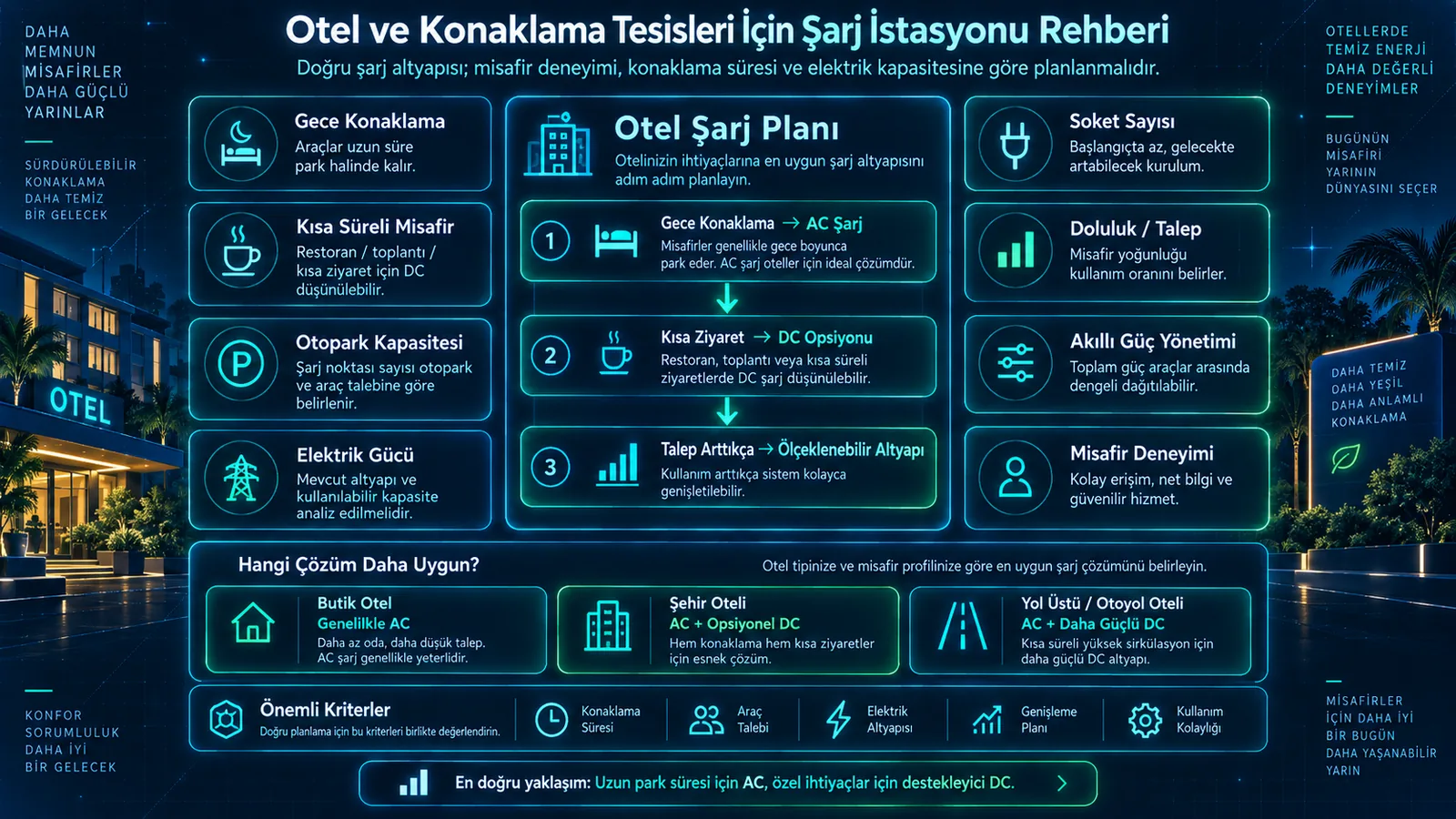
Table of contents
EV Charging Guide for Hotels and Accommodation
Hotel guests often leave their cars parked for six, eight, ten or more hours. Charging can therefore fit naturally into a stay. The best hotel installation is the one that reliably gives guests enough energy before departure, not necessarily the one with the largest kW figure.
Is AC enough for overnight guests?
Often, yes. Suppose a guest’s car has a 75 kWh usable battery and needs to move from 30% to 80%. The theoretical energy is 75 × 0.50 = 37.5 kWh. If the car accepts 11 kW AC, the ideal calculation is 37.5 ÷ 11 ≈ 3.4 hours. Real charging takes longer because of losses and changing conditions, but an eight-to-ten-hour overnight stay provides substantial time.
A 22 kW AC point will not make an 11 kW-limited car charge at 22 kW. Some vehicles accept only 7.4 or 11 kW AC. Choose the installation around the mix of guest vehicles, parking duration and available electrical capacity.
DC charging can make sense at a motorway hotel, a conference venue or another property where some guests stop for only 30–60 minutes. A hybrid AC/DC setup may serve both overnight and short-stay users, but DC is not an automatic requirement for every hotel.
| Property | Indicative vehicle stay | Option to evaluate |
|---|---|---|
| Boutique hotel | 8–12 hours | AC |
| City hotel | 8–12 hours | AC, possibly DC |
| Motorway hotel | 30 minutes–12 hours | AC and higher-power DC |
| Conference hotel | 2–10 hours | AC and/or DC |
How many charging points?
Begin with guest parking capacity, occupancy patterns and expected EV arrivals. A small property may start with a few AC points while preparing cable routes for more. A larger hotel may need more connectors even if the total charging power is limited. A guest unable to find a free bay gains little from a powerful charger elsewhere on the site.
Ten 11 kW AC points have 110 kW of combined nameplate power. If the hotel can allocate 60 kW, load management can share that power dynamically among connected cars. Overnight parking often gives enough time to reduce simultaneous demand without preventing guests from receiving the energy they need.
Assess the existing electrical installation, maximum building demand, protective equipment and expansion options before choosing chargers. Solar generation can be considered as part of the property’s wider energy system, but a charging plan still needs to account for nights and periods without generation.
Design the guest journey
Guests should know whether charging is available, how to access it, what it costs and whether a space can be reserved. Decide if charging is included in the room rate, separately billed or offered in another clearly stated way. Reservations can help when demand exceeds the number of points.
Locate bays so cables reach safely, vehicles can enter and leave easily, and other parking users are not blocked. At a hotel with valet service, define who connects and disconnects vehicles, how keys and vehicles are tracked, and when a charged car should move. An overnight charging bay cannot serve another guest if a completed session occupies it indefinitely.
For hotel chains, central monitoring can show availability, faults, energy use and utilization across properties. An OCPP-compatible management setup may help, subject to integration tests. Reliable operation and clear guest instructions matter more than a headline power figure. Collect usage data after launch and add capacity where real demand justifies it.
About the author
Charge Teknoloji
Charging Infrastructure Team
Charge Teknoloji develops locally manufactured DC charging stations and OCPP-compatible charging network software.
LinkedIn arrow_outwardBe the first to hear about updates
Follow new content on electric vehicles and charging technologies.