How to Calculate the Cost of Charging an Electric Car
Calculate EV charging cost using energy and unit price, battery state of charge, charging losses and consumption per 100 km.
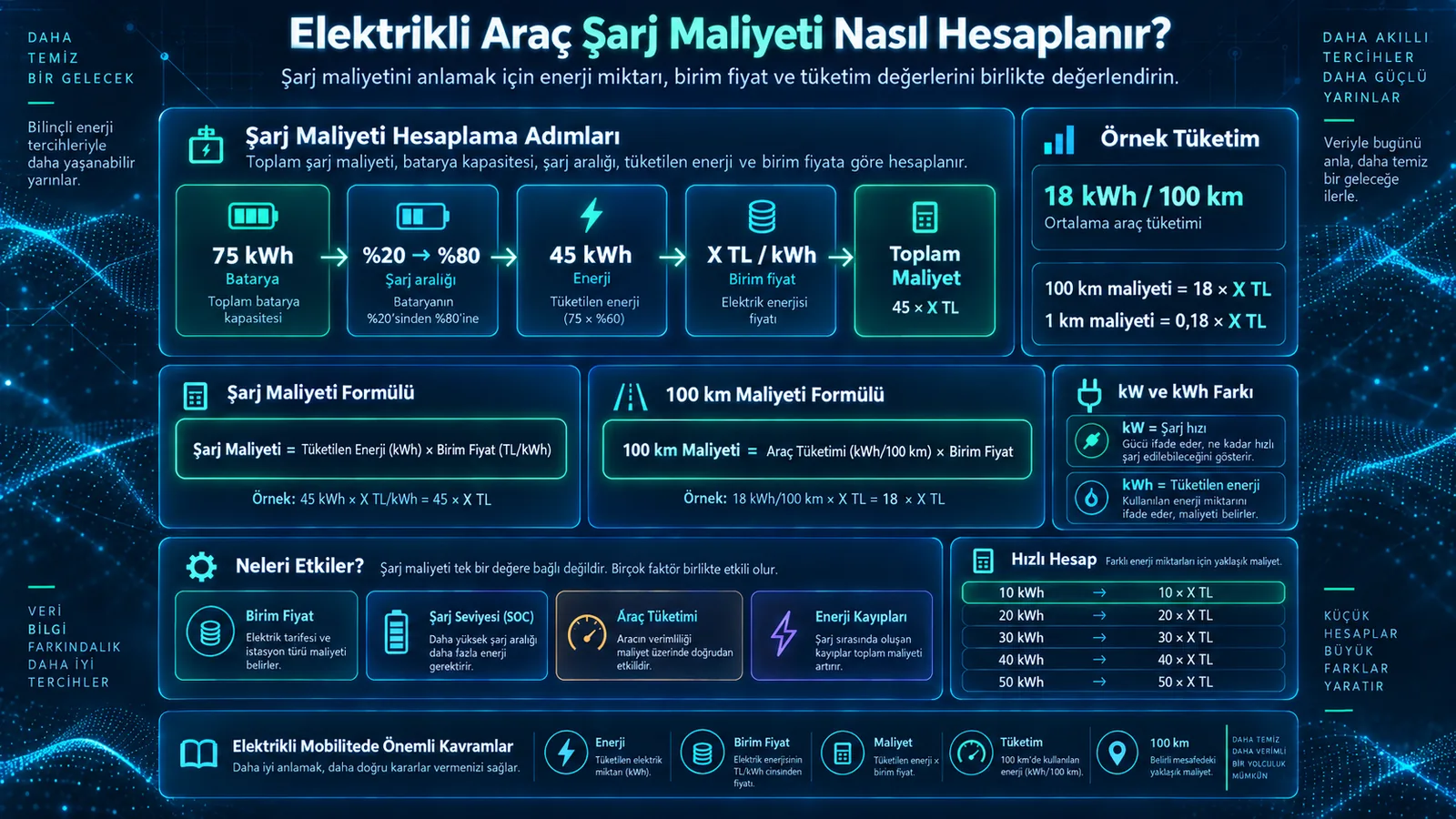
Table of contents
How to Calculate the Cost of Charging an Electric Car
The basic calculation is charging cost = energy billed (kWh) × unit price (TL/kWh). To estimate the energy before a session, you also need the battery’s usable capacity and the difference between its starting and target state of charge (SOC). Real bills may differ from a battery-based estimate because of charging losses and any additional location fees.
Why is charging priced in kWh?
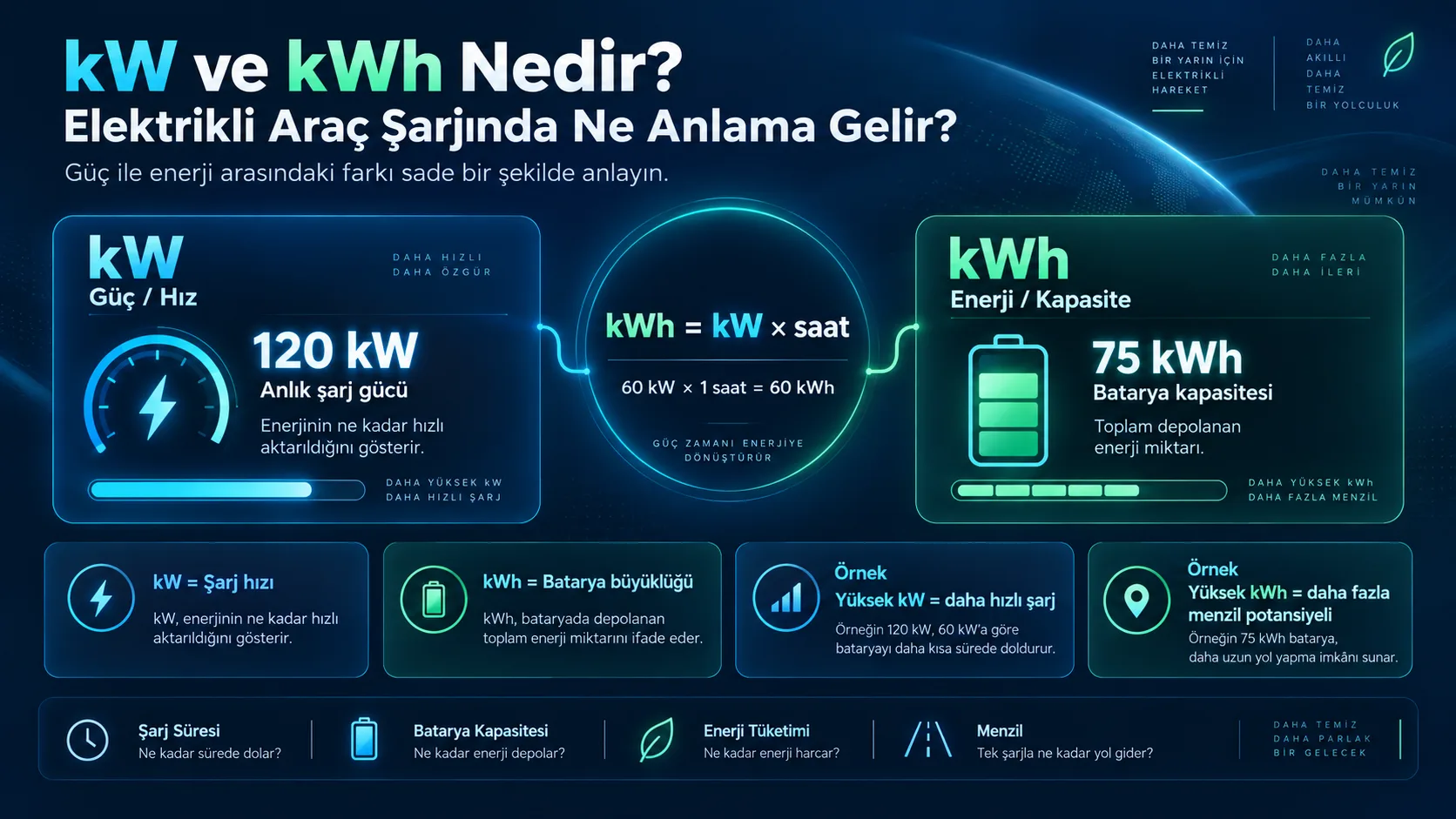
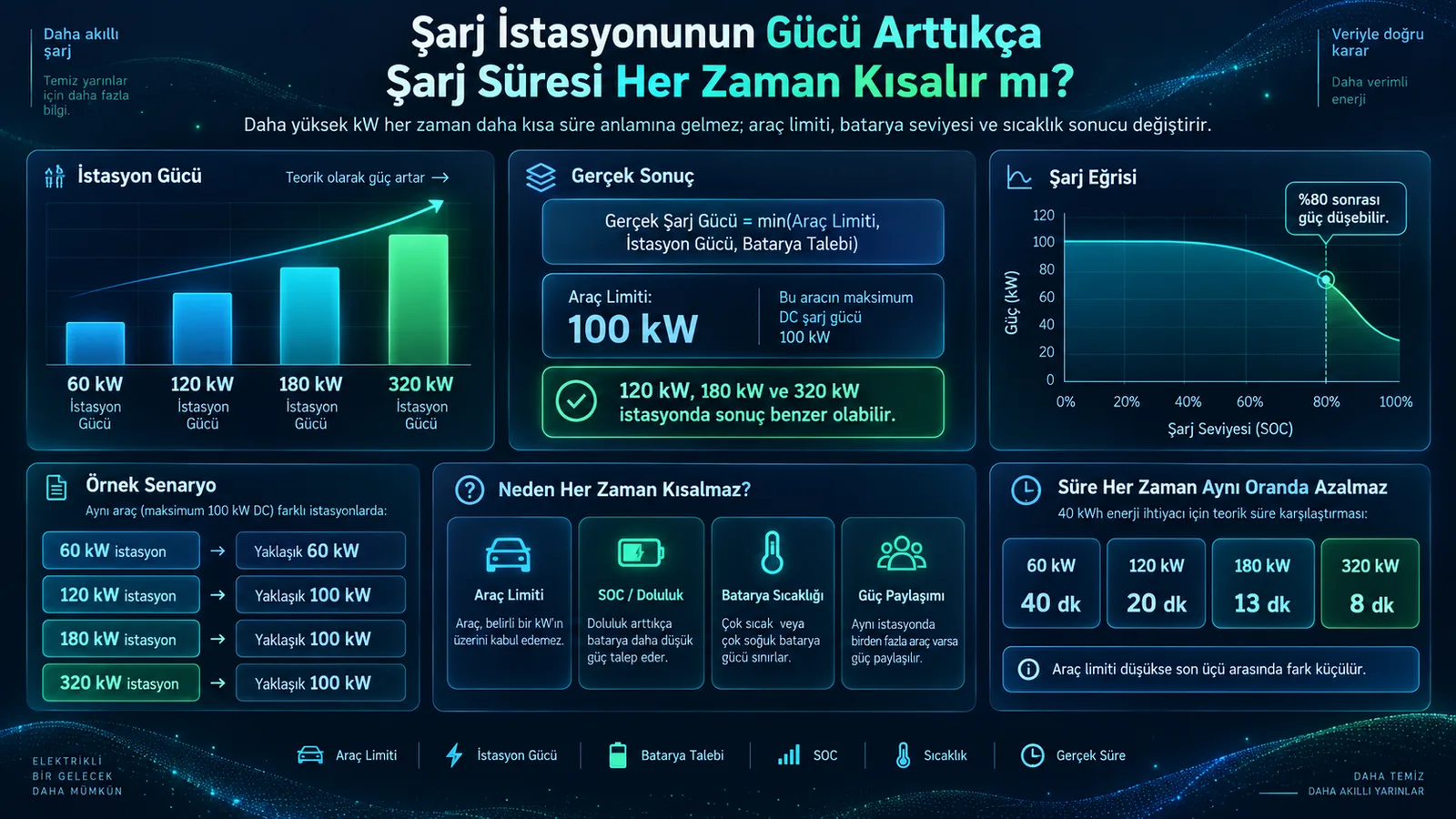
kW measures power, or how quickly energy can be delivered. kWh measures the amount of energy delivered. If a session supplies 35 kWh at a price of X TL/kWh, its energy charge is 35 × X TL. A 180 kW charger does not mean you have purchased 180 kWh; its rating describes available instantaneous power. Delivering the same 30 kWh from a 60 kW or 180 kW unit is the same quantity of energy, although the session time and tariffs can differ.
Estimate energy from battery capacity and SOC
Use energy added to battery ≈ usable battery capacity × (target SOC − starting SOC), with SOC expressed as a fraction. For a 75 kWh battery charged from 20% to 80%, the difference is 60%, so the theoretical energy added is 75 × 0.60 = 45 kWh. At X TL/kWh, the simple estimate is 45 × X TL.
For an 80 kWh battery going from 30% to 80%, the difference is 50%: 80 × 0.50 = 40 kWh. Going from 0% to 100% on a 60 kWh usable battery would theoretically add about 60 kWh, but drivers rarely make every session a complete empty-to-full charge.
Energy is also lost in cables, power electronics, thermal management and the battery system. The grid or charger might record 43 kWh while the battery gains 40 kWh. Check which energy quantity your tariff measures. If a session is billed at 48 kWh, multiply 48 × X, even if your battery-based estimate was 45 kWh.
Compare AC, DC and home tariffs
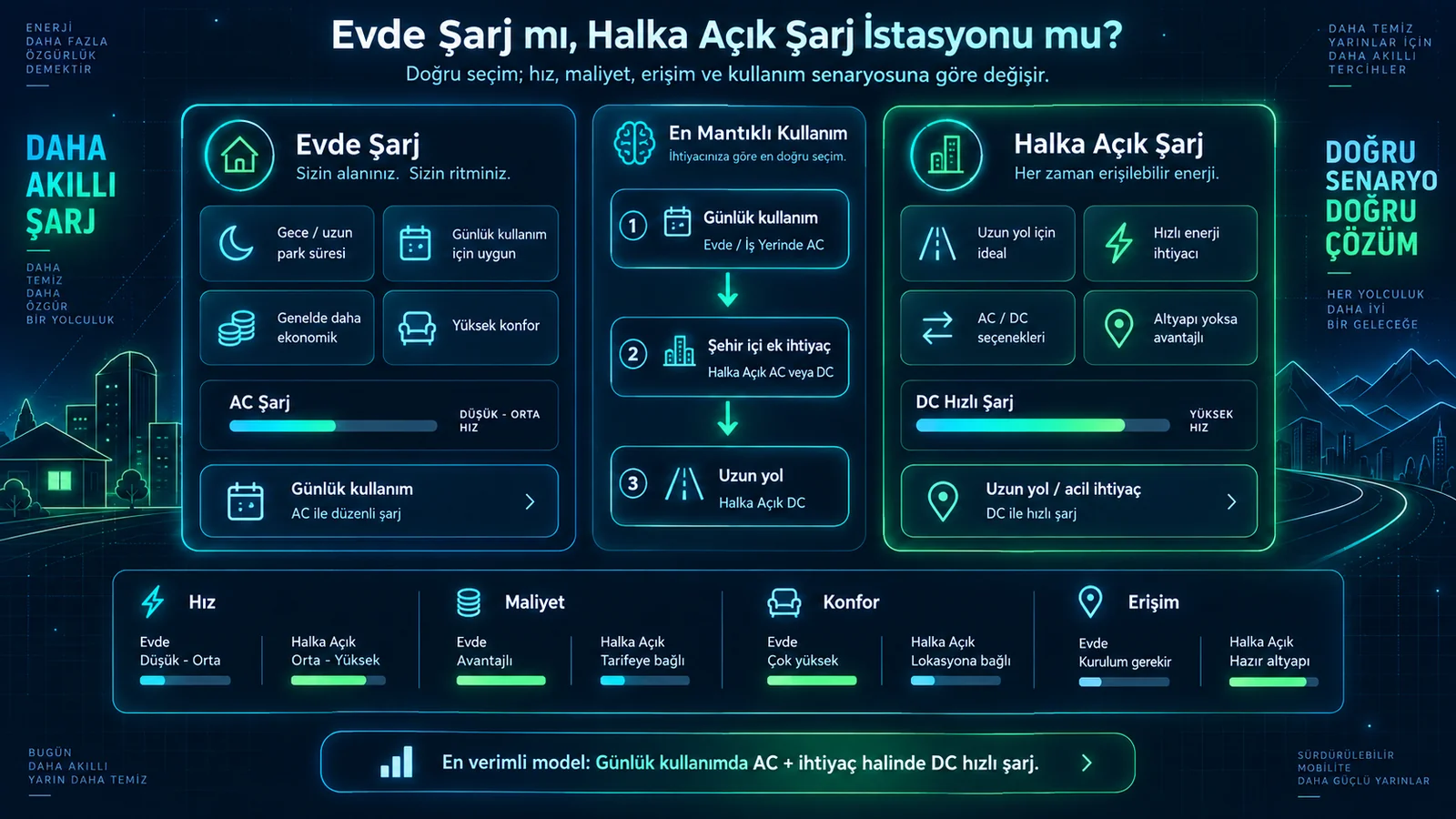
The energy unit is kWh for both AC and DC, but operators can set different prices for AC, lower-power DC and high-power DC. Home electricity tariffs may also vary by contract and time. A faster charger is not automatically more expensive per session if its tariff and delivered energy are the same, but a different tariff changes the result.
Also check for parking fees, overstay charges after charging ends or site-entry fees. They can affect the total cost beyond the energy charge.
Calculate cost per 100 km
For comparisons between vehicles and tariffs, use cost per 100 km = vehicle consumption (kWh/100 km) × unit price (TL/kWh). At 18 kWh/100 km, the energy cost is 18 × X TL per 100 km or 0.18 × X TL per km.
Use the car’s real average consumption when possible. Speed, weather, heating or air conditioning, road gradient, payload, tyre pressure and driving style all matter. A car might consume 15 kWh/100 km in city use and 22 kWh/100 km on a motorway, giving costs of 15 × X and 22 × X respectively.
Battery size and energy efficiency are different. A larger battery can take more energy when fully charged, but a car with an 80 kWh battery and 16 kWh/100 km consumption can cost less per kilometre than one with a 60 kWh battery and 20 kWh/100 km consumption.
Turn charged energy into approximate range
At 18 kWh/100 km, adding 36 kWh represents roughly 36 ÷ 18 × 100 = 200 km of theoretical driving. If that session cost Y TL, the approximate energy cost per 100 km is Y ÷ 2. At 20 kWh/100 km, one kWh represents about 5 km; at 15 kWh/100 km, about 6.7 km. Actual range changes with driving conditions.
| Energy added | Approximate range at 18 kWh/100 km | Energy cost |
|---|---|---|
| 10 kWh | 56 km | 10 × X TL |
| 20 kWh | 111 km | 20 × X TL |
| 30 kWh | 167 km | 30 × X TL |
| 40 kWh | 222 km | 40 × X TL |
| 50 kWh | 278 km | 50 × X TL |
Avoid two common mistakes
A 75 kWh car does not take 75 kWh every time it charges. Moving from 40% to 80% adds about 75 × 0.40 = 30 kWh to the battery before accounting for losses. Likewise, the station’s kW rating does not tell you how many kWh the session consumed.
For businesses, the customer’s energy price is only one part of the economics. Electricity procurement, connection capacity, equipment, maintenance, software, operation and location costs also affect a charging service. For a driver, the most useful numbers remain actual billed kWh, the applicable TL/kWh tariff and real vehicle consumption.
About the author
Charge Teknoloji
Charging Infrastructure Team
Charge Teknoloji develops locally manufactured DC charging stations and OCPP-compatible charging network software.
LinkedIn arrow_outwardBe the first to hear about updates
Follow new content on electric vehicles and charging technologies.